
Whose Voice Are You Following? — A Six-Part Bible Study
Primary Scriptures: Psalm 23; Ezekiel 34; Luke 15:1–7; John 9:1–41; John 10:1–30
In Part 1, we explored why Scripture compares people to sheep.
Sheep can wander, follow the wrong leader, and find themselves in danger without realizing it. They need someone who knows the way and cares enough to lead them.
But the Bible doesn’t leave us with a picture of wandering sheep.
It introduces us to the Shepherd.
Jesus said:
“I am the good shepherd. The good shepherd lays down his life for the sheep.”
— John 10:11 (ESV)
We’ve heard Jesus called the Good Shepherd so often that we may overlook what He was declaring.
He wasn’t simply giving people a comforting illustration.
He was revealing who He is.
And to understand the significance of His words, we need to begin with what God had already revealed about Himself.
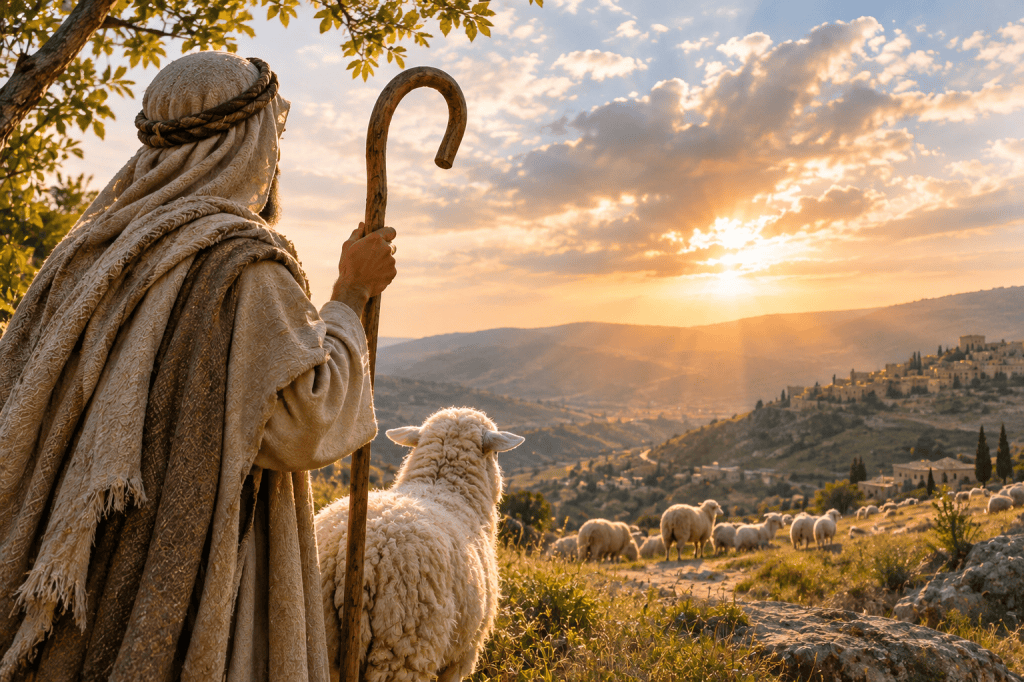
God Promised to Be the Shepherd of His People
Open your Bible to Ezekiel 34:11–16, 23–24.
The prophet Ezekiel spoke to God’s people during a time of judgment and exile. Israel’s leaders had failed to care for those entrusted to them, and the people had been scattered.
In the middle of this, God made a remarkable promise:
“For thus says the Lord GOD: Behold, I, I myself will search for my sheep and will seek them out.”
— Ezekiel 34:11 (ESV)
Notice who says He will search for the sheep.
God Himself.
Read verses 11–16 and notice the actions God promises to take.
He will search for the lost, bring back the strayed, bind up the injured, and strengthen the weak.
He will gather His scattered people and care for them.
These were promises made to Israel in a specific historical setting, but they also reveal God’s character. He is not indifferent to the condition of His people.
Then read verses 23–24.
God promises to establish one shepherd over His people, whom He calls “my servant David.”
David had lived centuries earlier. This promise points forward to the promised ruler from David’s line—the Messiah.
Keep that promise in mind as we turn to the words of Jesus.
In John 10, Jesus doesn’t simply say that God is like a shepherd.
He says:
“I am the good shepherd.”
And later:
“I and the Father are one.”
— John 10:30 (ESV)
Jesus is making a claim far greater than being a compassionate teacher or a good example.
He is revealing His identity as the Son of God, the promised Messiah, and the Shepherd of God’s people.
To understand what that means for us, let’s look at how Scripture describes His relationship with His sheep.

The Shepherd Knows His Sheep
Read John 10:1–18, paying particular attention to verses 3, 14–15.
Imagine looking across a field filled with sheep.
To someone unfamiliar with them, they might all look alike.
But a shepherd who cares for his flock learns to recognize individual animals, their behavior, and their needs.
Jesus uses the relationship between shepherd and sheep to reveal something about His relationship with those who belong to Him.
“I am the good shepherd. I know my own and my own know me.”
— John 10:14 (ESV)
And in verse 3, He describes the shepherd calling his sheep by name and leading them out.
Jesus doesn’t describe His sheep as anonymous members of a crowd.
He knows His own.
Later, He says:
“My sheep hear my voice, and I know them, and they follow me.”
— John 10:27 (ESV)
Notice the relationship Jesus describes.
He knows His sheep.
They hear His voice.
They follow Him.
This is more than knowing facts about Jesus or being familiar with Christian language.
Jesus describes a relationship marked by belonging to Him and following His voice.
And that raises a question worth considering.
Is it possible to know a great deal about Jesus without actually following Him?
Jesus’ words invite us to examine that question rather than assume we already know the answer.

Every Sheep Matters to the Shepherd
Read Luke 15:1–7.
Imagine having one hundred sheep.
Ninety-nine are accounted for, but one is missing.
Would one missing sheep matter enough to go looking?
Jesus tells a parable about a shepherd who does exactly that.
“What man of you, having a hundred sheep, if he has lost one of them, does not leave the ninety-nine in the open country, and go after the one that is lost, until he finds it?”
— Luke 15:4 (ESV)
The shepherd doesn’t dismiss the loss because he still has ninety-nine.
He searches for the one.
And when he finds it, he carries it home on his shoulders, rejoicing.
Each sheep matters to the Shepherd. Even the one that wandered away.
But before we decide what this parable means, we need to look at why Jesus told it.
Read Luke 15:1–2.
Tax collectors and sinners were drawing near to Jesus, and the Pharisees and scribes were complaining because He welcomed them.
Jesus responded by telling the parable of the lost sheep.
Then He explained:
“Just so, I tell you, there will be more joy in heaven over one sinner who repents than over ninety-nine righteous persons who need no repentance.”
— Luke 15:7 (ESV)
Jesus isn’t teaching that the ninety-nine are unimportant.
He is revealing God’s concern for the lost and the joy of repentance.
The shepherd’s search is not merely a picture of helping someone through a difficult season. Jesus specifically connects it to sinners turning to God.
Think about the people the religious leaders were criticizing.
Jesus welcomed them.
He didn’t treat them as beyond God’s concern.
And He didn’t tell them that repentance was unnecessary.
The Shepherd’s concern for the lost includes calling them back to God.
Now return to Ezekiel 34:16.
God had promised to seek the lost and bring back the strayed.
Centuries later, Jesus is teaching about the joy of finding the lost.
And in Luke 19:10, Jesus explains that the Son of Man came to seek and save the lost.
The connection is worth examining for yourself.
Consider: When you read Luke 15 in its context, what does it reveal about God’s attitude toward sinners? What does it teach about repentance?

His Rod and Staff Comfort Us
Read Psalm 23:1–6.
David begins:
“The LORD is my shepherd; I shall not want.”
— Psalm 23:1 (ESV)
Throughout the psalm, David describes the Lord providing, restoring, and guiding him.
He leads David beside still waters and in paths of righteousness.
But then the setting changes.
David describes walking through the darkest valley.
And he says:
“Even though I walk through the valley of the shadow of death, I will fear no evil, for you are with me; your rod and your staff, they comfort me.”
— Psalm 23:4 (ESV)
Why would a rod and staff bring comfort?
A shepherd’s rod was generally a shorter, sturdy implement used for protection and handling animals.
The staff was longer, sometimes with a curved hook at the top called a crook.
A shepherd could use the staff to guide sheep, direct them through passages, separate an individual animal from the flock, or carefully catch and steady a sheep that needed attention. The curved crook helped with handling sheep when necessary.
These were practical tools used in caring for a flock.
David doesn’t explain a separate spiritual meaning for every feature of the rod or staff. Instead, he describes the comfort of knowing that his Shepherd is with him.
Notice what David doesn’t say.
He doesn’t say that belonging to the Lord means he will never walk through a dangerous valley.
He says that even in the valley, the Shepherd is present.
And consider where the Shepherd leads him.
“He leads me in paths of righteousness for his name’s sake.”
— Psalm 23:3 (ESV)
A good shepherd doesn’t simply follow the sheep wherever they decide to go.
He leads them.
God’s guidance is not always about giving us the direction we would have chosen for ourselves.
Sometimes His Word corrects our thinking.
Sometimes it exposes something in our lives that needs to change.
Sometimes it calls us away from a path that seems right to us.
Scripture also teaches that God disciplines those He loves (Hebrews 12:5–11).
His correction is not something we should automatically interpret as rejection.
The Shepherd’s guidance is an expression of His care.
Read Isaiah 40:10–11 alongside Psalm 23.
Isaiah describes the Lord coming with power, then tenderly gathering lambs in His arms and gently leading those who need special care.
God’s strength and gentleness are not opposites.
Both are part of the character He reveals.
Consider: When God’s Word challenges a belief or choice you’ve made, are you willing to follow where it leads? Do you trust His character even when the path is difficult?

Not Every Shepherd Is a Good Shepherd
Read Ezekiel 34:1–10; Matthew 7:15–20; Acts 20:28–31; John 10:1–13.
Now that we’ve seen what Scripture reveals about the Good Shepherd, we can better understand its warnings about those who claim to lead God’s people.
Return to the beginning of Ezekiel 34.
God confronts Israel’s leaders:
“Ah, shepherds of Israel who have been feeding yourselves! Should not shepherds feed the sheep?”
— Ezekiel 34:2 (ESV)
Read verses 3–4 carefully.
What were these leaders doing?
And what were they failing to do?
They benefited from the flock while neglecting the weak, injured, and wandering.
Compare their actions with God’s promises in verses 11–16.
The difference is striking.
God promises to seek the lost.
These leaders had not sought them.
God promises to strengthen the weak.
These leaders had neglected them.
God promises to care for His flock.
These leaders had used their positions for themselves.
But Scripture’s warnings go beyond neglectful leadership.
Wolves in Sheep’s Clothing
Jesus warned:
“Beware of false prophets, who come to you in sheep’s clothing but inwardly are ravenous wolves.”
— Matthew 7:15 (ESV)
Think about the picture Jesus chose.
A wolf in sheep’s clothing doesn’t appear to be a threat.
It appears to belong among the sheep.
That is what makes the warning so serious.
Jesus doesn’t tell His followers to assume that everyone who appears religious is trustworthy.
He tells them:
“You will recognize them by their fruits.”
— Matthew 7:16 (ESV)
Read the rest of Matthew 7:15–20.
Jesus directs our attention beyond outward appearances to what a person’s life produces.
And the apostle Paul gives an equally sobering warning to the elders of the church in Ephesus.
“I know that after my departure fierce wolves will come in among you, not sparing the flock.”
— Acts 20:29 (ESV)
Then he warns that people will even arise from within the church, speaking twisted things to draw disciples after themselves (Acts 20:30).
Notice the danger.
These people aren’t necessarily announcing that they oppose Jesus.
They may be speaking from within the church.
And they may be drawing followers toward themselves by distorting the truth.
Jeremiah 23:16 also warns about prophets speaking visions from their own minds rather than from the mouth of the Lord.
This is why a religious title, a confident message, a large following, or even the use of Bible verses cannot by itself establish that someone is faithfully teaching God’s Word.
We must examine what is being taught against what Scripture actually says.
But how?
Scripture gives us guidance.
Read 1 John 4:1–6. John tells believers to test the spirits because many false prophets have gone into the world, and he emphasizes the truth about Jesus Christ.
Read Acts 17:10–12. The Bereans examined the Scriptures daily to see whether Paul’s teaching was true.
Read 2 Timothy 3:16–17. Paul explains the role of God-breathed Scripture in teaching, correction, and training in righteousness.
Together, these passages point us toward an essential principle:
We don’t determine truth by how convincing someone sounds. We examine their message in light of God’s Word.
That includes the words you’re reading in this study.
Don’t accept a conclusion simply because it is written here.
Open the passages. Read what comes before and after. Examine what the authors were teaching and how the passages fit with the rest of Scripture.
Faithful teachers should direct us toward God’s Word, not make us dependent on their own authority.
And we should remember that not every leader who makes a mistake is a false shepherd. Scripture also describes faithful leaders who serve God’s people and remain accountable to Christ (1 Peter 5:2–4).
The question isn’t whether a teacher is perfect.
It is whether their teaching and conduct faithfully reflect the truth of Scripture.
Consider: When you hear a teaching that sounds convincing, do you examine it in Scripture? Are you as willing to question a teaching you already agree with as one you dislike?
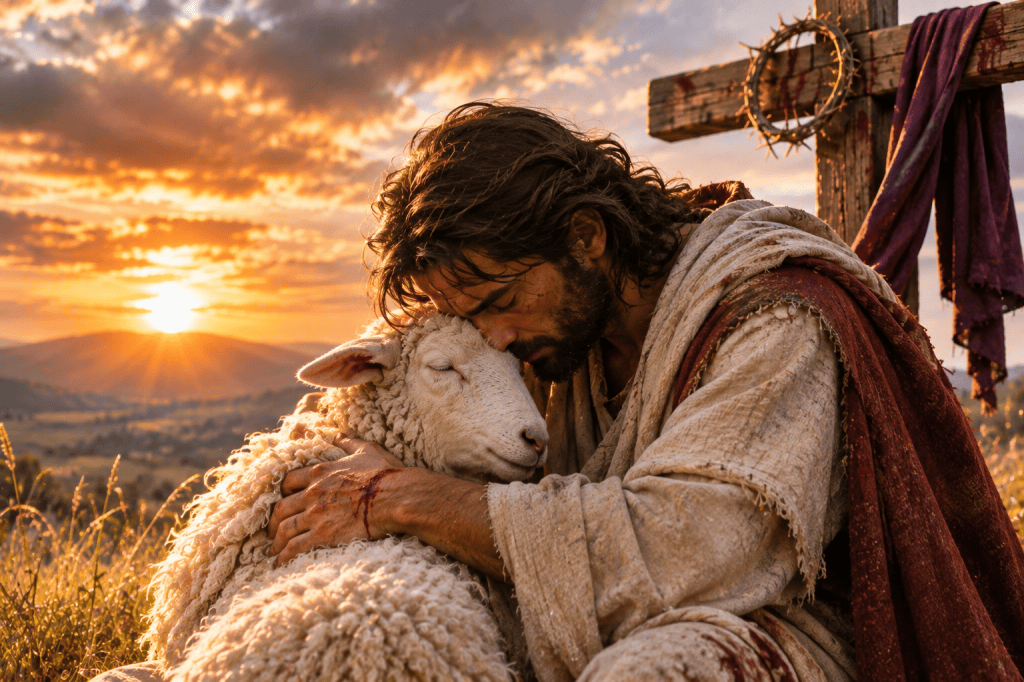
The Good Shepherd Lays Down His Life
Read John 9:1–41 and John 10:11–18.
There is something important about the setting of Jesus’ words in John 10.
In the previous chapter, Jesus healed a man who had been blind from birth.
The religious leaders questioned the man repeatedly and eventually cast him out.
Then John tells us:
“Jesus heard that they had cast him out, and having found him he said, ‘Do you believe in the Son of Man?’”
— John 9:35 (ESV)
The religious leaders cast him out.
Jesus found him.
And when the man came to recognize who Jesus was, he believed and worshiped Him.
Read John 9 for yourself. Notice how the man who had been physically blind came to see who Jesus was, while the leaders who claimed spiritual understanding failed to recognize Him.
Then read Jesus’ words in John 10.
He contrasts the shepherd with the hired hand who abandons the sheep when danger comes.
And He declares:
“I am the good shepherd. The good shepherd lays down his life for the sheep.”
— John 10:11 (ESV)
Jesus doesn’t simply tell us that He cares.
He demonstrates the depth of that care through His sacrifice.
He goes on to explain:
“No one takes it from me, but I lay it down of my own accord. I have authority to lay it down, and I have authority to take it up again.”
— John 10:18 (ESV)
Jesus willingly gave His life and rose again.
Why was that necessary?
Return to Isaiah 53:6:
“All we like sheep have gone astray; we have turned—every one—to his own way; and the LORD has laid on him the iniquity of us all.”
— Isaiah 53:6 (ESV)
The problem of wandering sheep is much greater than occasionally making a poor decision.
Scripture tells us that we have all turned to our own way.
We have sinned against God.
And we cannot reconcile ourselves to Him through our own efforts.
Jesus, the Good Shepherd, laid down His life for His sheep.
Through His death and resurrection, He provides the way for sinners to be reconciled to God.
He doesn’t merely offer better advice about how to live.
He offers salvation.
And in John 10:28, Jesus promises eternal life to His sheep.
This is what makes His claim to be the Good Shepherd so extraordinary.
He knows His sheep.
He calls them.
He cares for them.
And He gives His life for them.
No human shepherd can take His place.

Do We Know His Voice?
We’ve looked at what God revealed about Himself through the prophets, what David wrote about the Lord as his Shepherd, and what Jesus taught about His relationship with His sheep.
We’ve also seen why Scripture warns us about those who claim to speak for God but lead people away from His truth.
Now return to John 10:27.
“My sheep hear my voice, and I know them, and they follow me.”
— John 10:27 (ESV)
Jesus describes His sheep as those who hear and follow Him.
That brings us to a question we shouldn’t answer too quickly.
How can we recognize the Shepherd’s voice if we don’t know what He has said?
There are countless voices telling us what God thinks, what Jesus would approve of, what the Bible means, and what it means to be a Christian.
Some speak with confidence.
Some sound compassionate.
Some are persuasive.
Some may even tell us exactly what we want to hear.
But none of those things makes a message true.
God has given us His Word.
And He calls us to know Him, trust Him, and follow Him.
Not merely the version of Him someone else has described.
Not simply the Jesus we’ve imagined.
The Jesus revealed in Scripture.
Go Deeper: Open the Word for Yourself
Before continuing to Part 3, take time to examine these passages in your own Bible.
- Ezekiel 34:11–16: What does God promise to do for His sheep? What does this reveal about His character?
- Luke 15:1–7: Why did Jesus tell the parable of the lost sheep? What does the surrounding conversation reveal about its meaning?
- Psalm 23:1–6: What does David say the Lord provides? What gives David confidence when he walks through danger?
- Matthew 7:15–20 and Acts 20:28–31: What dangers does Scripture warn us about? How can someone appear trustworthy while leading others away from truth?
- John 10:1–30: What does Jesus say about Himself, His sheep, and the life He gives them?
And one final question:
Am I learning to recognize Jesus through His Word, or am I relying on what other people tell me about Him?
Coming Next: Part 3 — How Do We Recognize the Shepherd’s Voice?
Jesus says His sheep hear His voice and follow Him.
But with so many voices competing for our attention, how do we recognize what is truly from God?
In Part 3, we’ll examine what Scripture teaches about recognizing truth, testing what we hear, and learning to follow the voice of the Good Shepherd.
Even If, Still
Even if I cannot see where the path leads, still, I will trust the Shepherd who knows the way.


Leave a Reply