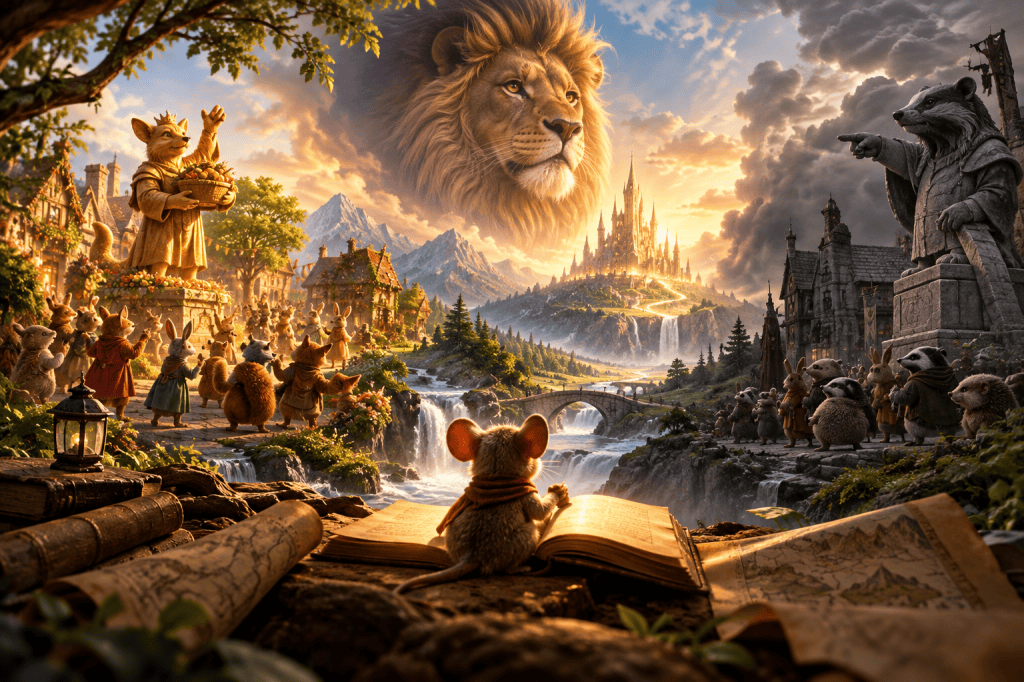
An allegory of a forgotten Book, a thousand roads, and the King who had already made a way home.
Once Upon a Time in Evermere
Beyond the mountains of Morninglight, past the Silverwood Forest and the River of Remembering, lay a kingdom called Evermere.
It was a beautiful place.
Rabbits tended gardens overflowing with flowers. Foxes built cottages beneath enormous oak trees. Badgers carved homes into the hillsides, and mice lived in little houses with round windows and warm fireplaces.
The mountains caught the first light of morning, and the rivers carried their waters toward a sea no creature had ever crossed.
But Evermere had not always existed.
Long before the first tree stretched toward the sun, before the rivers found their courses or the mountains rose from the earth, there was the King.
He had made it all.
Every stone, every star, every living creature owed its existence to Him.
He was not merely the ruler of Evermere. He was its Creator.
And He was good.
The King was loving and merciful, but also holy and just. He delighted in His creation, yet He would not call evil good simply because His creatures wished Him to.
Long ago, when the creatures had turned away from Him, the King had done something extraordinary.
He had entered the very world He had made.
He had walked among His creatures, spoken truth they did not always wish to hear, and given Himself to rescue those who could never find their way home on their own.
Before returning to His throne, He ensured that His words and the account of His great rescue would be preserved in a Book.
The Book told of the beginning of all things, the rebellion of the creatures, the faithfulness of the King, and the way home.
It was a precious gift.
And for a time, the creatures treasured it.
But generations passed.
The Book was placed on beautiful shelves. Its cover was embroidered onto banners. Its words were carved above doorways.
Creatures spoke proudly of possessing it.
Some even carried little copies wherever they went.
Yet fewer and fewer opened its pages.
And gradually, the kingdom began to forget the King.
Not His name, of course.
Everyone still knew His name.
They had simply forgotten who He was.
The Village of Pleasant Things
In a sunny valley stood the Village of Pleasant Things.
Here lived Pippin the fox and his dear friend Buttercup the rabbit.
Their village was famous for its festivals, sweet cakes, colorful lanterns, and cheerful songs about the King.
At the center of the village stood a magnificent golden statue.
It portrayed a smiling king holding a basket overflowing with fruit, flowers, and little golden treasures.
The villagers called him the Generous King.
Every morning, Pippin stopped beside the statue.
“Good morning, Your Majesty!” he would say. “Thank you for another wonderful day. And if You could arrange for a little extra sunshine and perhaps a larger harvest, that would be splendid!”
Buttercup often left flowers at the statue’s feet.
“The King wants us to be happy,” she told the younger rabbits. “That’s how we know He loves us.”
Whenever something good happened, the villagers praised the golden king.
When a harvest was plentiful, they thanked him.
When a business prospered, they celebrated his favor.
When someone recovered from an illness, they hung another golden ribbon around his basket.
And when something unpleasant happened?
Well, that was more difficult.
Perhaps they had not been grateful enough.
Perhaps they had forgotten to ask correctly.
Perhaps they simply needed to believe more strongly that good things were coming.
No one liked discussing such matters for long. They made the village feel less pleasant.
One afternoon, Pippin discovered an old copy of the King’s Book in his grandmother’s cupboard.
He opened it and began reading aloud.
“‘Take up your cross and follow Me—’”
He frowned.
“That sounds rather uncomfortable.”
He turned a few pages.
“‘In the world you will have tribulation—’”
“Goodness!” Buttercup exclaimed. “That doesn’t sound like our King at all.”
Pippin closed the Book.
“Perhaps these passages are meant for someone else.”
Together they began drawing a map.
They called it The Road of Blessings.
It was a lovely map, decorated with sunshine, flowers, and cheerful little cottages.
The road was wide, smooth, and lined with promises of happiness.
There were no steep mountains, no dark valleys, and certainly no crosses.
The villagers loved it.
Soon every home displayed a copy.
And the golden statue stood smiling over them all.
The Village of Righteous Creatures
Across the river stood another village.
It was called the Village of Righteous Creatures.
Here lived Bartholomew the badger.
Bartholomew was a serious creature who believed strongly in doing things properly.
He rose early, worked diligently, and maintained a remarkable collection of rules.
He also possessed a very large copy of the King’s Book, which rested on a carved wooden stand in his sitting room.
Unlike Pippin, Bartholomew read from it frequently.
Or rather, he read certain parts frequently.
He particularly enjoyed passages about judgment, obedience, and the foolishness of wicked creatures.
He was less enthusiastic about passages concerning mercy, humility, loving enemies, or examining one’s own heart.
At the center of his village stood an enormous stone statue.
It portrayed a stern king with narrowed eyes and one long finger pointing toward the horizon.
The villagers called him the Holy King.
Bartholomew liked to imagine that the finger was pointing toward the Village of Pleasant Things.
“Look at those foolish creatures,” he would say. “Always celebrating. Always asking for gifts. They have no respect for the King!”
The other badgers nodded.
They were proud of their discipline.
They had rules about clothing, rules about eating, rules about speaking, and rules about which creatures were respectable enough to enter their village.
Some rules came from the Book.
Others had been invented long ago, but nobody remembered which were which.
Eventually, Bartholomew created a map of his own.
He called it The Road of Righteousness.
It was narrow and surrounded by fences, with guarded gates at every turn.
At the entrance stood a sign:
ONLY THE WORTHY MAY PASS.
Bartholomew was quite pleased with it.
He hung a copy beside his fireplace and admired how carefully he had marked every forbidden path.
When a young badger asked what the King had said about loving one’s enemies, Bartholomew waved a paw dismissively.
“Of course we love our enemies. We love them enough to tell them how wrong they are.”
“And what about mercy?” asked the youngster.
“Mercy is important,” Bartholomew replied, “provided it doesn’t interfere with righteousness.”
The young badger looked toward the stone king.
His finger pointed sternly into the distance.
She wondered why it never pointed toward their own village.
But she said nothing.
The Little Mouse with the Dusty Book
Between the two villages, beside a winding stream, lived a little mouse named Wren.
Wren was neither particularly important nor especially brave.
She liked warm tea, blackberry jam, and watching the stars from her cottage window.
One rainy afternoon, while searching her grandfather’s attic for a missing teapot, she discovered an old wooden chest.
Inside lay a Book.
Its cover was worn, its pages yellowed, and a ribbon marked a place near the middle.
Wren recognized it immediately.
Everyone in Evermere knew of the King’s Book.
But Wren realized, with some embarrassment, that she had never actually read it.
She carried it downstairs, made herself a cup of tea, and began at the beginning.
She read about the King creating the heavens and the earth.
She read about creatures who had turned away from their Creator and tried to decide good and evil for themselves.
She read about justice, mercy, faithfulness, rebellion, forgiveness, and love.
And then she came to the account of the King entering His own creation.
He had not come merely to make everyone comfortable.
Nor had He come to congratulate those who considered themselves righteous.
He had come to seek and save the lost.
He spoke truth.
He exposed hypocrisy.
He welcomed repentant sinners.
He called His creatures to follow Him, even when the road was difficult.
And He gave His life to rescue them.
Wren read late into the night.
At times she smiled.
At times she wept.
And sometimes she had to close the Book and sit quietly, because what she had read was so different from what she had always assumed.
The King was more loving than she had imagined.
He was also far holier.
His mercy was greater.
His truth was sharper.
And His invitation demanded far more than admiration from a distance.
The next morning, Wren spread the two village maps across her kitchen table.
She compared them with the Book.
Then she compared them again.
The Road of Blessings had forgotten the King’s call to surrender.
The Road of Righteousness had forgotten that no creature could earn its own rescue.
One had made the King a servant of their desires.
The other had made Him a champion of their pride.
Neither map showed the King as He had revealed Himself.
Wren looked down at the Book.
“Oh dear,” she whispered.
Two Villages, Two Kings
Wren first visited the Village of Pleasant Things.
Pippin welcomed her warmly and offered her a honey cake.
“I’ve been reading the King’s Book,” Wren began.
“How wonderful!” said Buttercup. “Isn’t He generous?”
“Very,” Wren replied. “But I think there’s more to Him than we’ve been saying.”
She opened the Book and read about following the King through hardship, trusting Him even when life was difficult, and seeking His kingdom above their own comfort.
Pippin’s smile faded.
“But the King wants us to be happy.”
“He loves us,” Wren answered. “But I don’t think He ever promised that loving Him would mean never suffering.”
Buttercup glanced uneasily at the golden statue.
“Then why does our king always look so pleased?”
Wren looked up at the smiling golden face.
“Who decided what he should look like?”
Pippin straightened.
“We did, of course.”
“And who decided what he would promise?”
Pippin opened his mouth.
Then closed it.
He looked toward the villagers gathered beneath the golden basket.
“Our map has brought everyone so much hope,” he said at last. “Surely that counts for something.”
Wren looked at the cheerful road drawn across the parchment.
“Perhaps,” she said gently. “But does it lead where the King told us to go?”
Pippin folded the map.
“I think,” he said, “we’ve discussed enough unpleasant things for one afternoon.”
So Wren crossed the river.
Bartholomew received her with considerably less enthusiasm.
“I understand you’ve been questioning the other village’s beliefs,” he said. “Good. They need correcting.”
“I’ve been reading the King’s Book,” Wren replied. “And I hoped we might read some of it together.”
Bartholomew smiled approvingly.
“An excellent idea.”
But when Wren opened to passages about pride, mercy, and the danger of trusting in one’s own righteousness, his smile disappeared.
“We are not like those creatures across the river,” he said.
“I know,” Wren answered. “But the Book seems to warn us about looking down on others.”
“Are you suggesting that our village is unrighteous?”
“I’m suggesting we might all need the King’s mercy.”
Bartholomew rose from his chair.
“Be careful, little mouse. You seem to have forgotten who has spent years studying these matters.”
Wren glanced at the great Book on its carved stand.
Then at the map beside it.
Then at the stone king outside the window.
“Perhaps,” she said quietly, “we’ve all forgotten something.”
Bartholomew escorted her to the door.
The Lion in the Forest
Wren returned home discouraged.
She had shown the villagers the words of the King, yet neither village seemed willing to reconsider its map.
That evening she wandered into the Silverwood Forest.
She walked until the familiar paths disappeared and the trees grew tall around her.
At last she came to a clearing bathed in moonlight.
There, beside a quiet stream, stood a Lion.
His mane shimmered like gold beneath the stars. His eyes were steady and searching, and Wren felt as though every secret thought she had ever carried was already known to Him.
She knew, somehow, that she stood before the King.
Wren bowed her head.
“Your Majesty,” she whispered. “They won’t listen.”
The Lion regarded her.
“And you, little one? Have you listened?”
Wren blinked.
“I’ve read Your Book.”
“Yes.”
“And I’ve tried to tell them the truth.”
“Yes.”
She hesitated.
“I suppose I’ve begun to think I’m rather better than they are.”
The Lion’s gaze did not waver.
Wren lowered her ears.
“Oh.”
For a while, neither spoke.
Then Wren thought of the two statues.
“The golden king is made from metal,” she said slowly. “And the stone king from rock.”
“Which I made,” said the Lion.
“And the creatures who fashioned them?”
“Mine as well.”
Wren looked at her own small paws.
The created had taken the Creator’s gifts and fashioned gods they could control.
They had not merely forgotten who the King was.
They had forgotten who they were.
“Why do they do it?” she asked.
“Because a king of their own making will never ask them to surrender what they wish to keep.”
Wren thought of Pippin’s desire for comfort.
Of Bartholomew’s desire to be right.
And of her own desire to feel wiser than everyone else.
“Even I was making a map,” she whispered.
She had been so certain that she understood the King better than the others. And perhaps she did understand some things they had missed. But somewhere along the way, she had begun using the Book to prove herself right rather than allowing it to reveal where she, too, needed correction.
The Book had not been given so she could stand above the other creatures. It had been given so that every creature, including her, could discover who the King truly was.
The Lion stepped closer.
“The Book was never given so that you might stand above the others. It was given so that you might know Me.”
Wren lifted her eyes.
“Then how do we find the way home?”
The Lion turned toward a narrow path leading beyond the trees.
“The Book tells you who I am and what I have done. But the way home is not a road you can invent or a prize you can earn.”
He looked back at her.
“Follow Me.”
And Wren followed.
The Day the Statues Fell
The storm came without warning.
By evening, the rivers had risen, the trees bent beneath the wind, and rain swept through the streets of Evermere.
In the Village of Pleasant Things, Pippin and Buttercup hurried to the square where their golden king stood smiling, his arms forever extended with a basket of gifts.
“Surely he will protect us,” Pippin said. “We have praised him. We have thanked him. We have asked for nothing but good things.”
But the wind howled, and the rain fell harder.
A crack appeared across the statue’s golden face.
Buttercup stared at it.
“Perhaps we haven’t been grateful enough.”
“We’ve done everything right!” Pippin cried.
Then lightning flashed, the earth trembled, and the golden king toppled from his pedestal.
His basket shattered against the stones, scattering its painted fruit into the rushing water.
The creatures stood motionless.
For years they had come to that square expecting blessings.
They had believed that if they praised the King enough, good things would surely follow.
Now their homes were flooded, their gardens ruined, and their smiling king lay broken at their feet.
One little rabbit knelt beside the fallen statue.
“Does this mean he doesn’t love us anymore?” she whispered.
No one answered.
Across the river, in the Village of Righteous Creatures, the animals had gathered beneath the stern stone king.
Bartholomew stood before them, clutching his carefully written rules.
“Remain calm!” he commanded. “We have followed the proper road. We have kept ourselves separate from those foolish creatures across the river. The King knows we are righteous!”
But the storm did not turn away from their village.
The same wind tore through their streets.
The same rain flooded their homes.
Then, with a terrible grinding sound, the stone king began to lean.
“Hold him!” Bartholomew shouted.
The creatures rushed forward, pressing their paws against the cold stone.
But no matter how hard they pushed, they could not keep him standing.
The statue crashed to the ground, its accusing finger breaking off and disappearing into the mud.
For a long moment, Bartholomew could only stare.
“But we followed every rule,” he whispered.
A young badger looked across the river at the ruins of the other village.
“If we were the righteous ones,” she asked quietly, “why did the same storm come for us?”
Bartholomew opened his mouth.
But the answer he had always given suddenly sounded hollow.
By morning, the storm had passed.
Both villages were damaged.
Both statues lay in pieces.
And both roads, so carefully drawn and so confidently followed, had led the creatures to the same bewildering place.
Some were angry with the King.
Some wondered whether He had abandoned them.
Others wondered whether there had ever been a King at all.
And a few began to ask a question that frightened them more than the storm:
What if the King they had trusted was never the King who truly existed?
That afternoon, Wren crossed the muddy bridge carrying the old Book.
She found Pippin sitting beside the broken golden basket and Bartholomew holding the stone finger that had once pointed toward everyone else’s failures.
Wren looked at the shattered statues.
Then at the grieving creatures.
She remembered how easily she, too, had begun to feel superior when she first discovered the Book.
So she did not smile at their fallen idols or remind them that she had warned them.
Instead, she sat down beside them.
“The King hasn’t changed,” she said gently. “But perhaps we have misunderstood who He is.”
Pippin looked at the broken golden face.
“Then why didn’t He give us what we asked for?”
Bartholomew gripped the stone finger.
“And why didn’t He reward us for doing everything right?”
Wren opened the Book.
“I think,” she said, “we should begin by discovering what He actually promised.”
For the first time in many years, the creatures gathered not to admire a statue, defend a map, or demand something from the King.
They gathered to listen.
The Last Page
Not every creature stayed to listen.
Some returned to the ruins and began rebuilding their statues.
Others drew new maps that looked remarkably like the old ones.
A few carried the Book proudly while continuing down roads that led in the opposite direction.
But others kept reading.
For years, the creatures had argued over which village understood the King. Each had been certain its road was right.
Yet hardly anyone had thought to ask whether the King agreed with them.
Now, for the first time, some were willing to find out.
They opened the Book—not to defend the roads they had chosen, but to discover where they might have misunderstood the King.
They discovered that the King was neither the smiling servant of their wishes nor the stern defender of their superiority.
He was their Creator.
He was holy and merciful.
And He had already done what none of their maps could accomplish.
He had made a way home.
The Book had not changed.
The King had not changed.
But in a little cottage beside a winding stream, another creature opened the Book for the very first time.
And began to read.
A Question Worth Asking
What if the greatest danger isn’t that we don’t believe in God, but that we’ve become so certain of who He is that we’ve stopped listening to what He says?
When was the last time you opened Scripture simply to discover who God is, rather than to confirm what you already believe?
Go Deeper: Discover the King
If this story stirred a question, consider exploring these passages for yourself:
- John 1:1–14 — Who is Jesus, and what does it mean that the Word became flesh?
- Colossians 1:15–20 — What does Scripture say about Christ as Creator and Lord?
- Romans 1:21–25 — How do people exchange the truth about God for something created?
- John 5:39–40 — Is it possible to know religious writings and still miss the One they reveal?
- John 14:6 — What does Jesus mean when He says He is the Way?
- Romans 12:2 — What does it look like to have our thinking transformed rather than shaped by the world?
Don’t just take the story’s word for it.
Open the Book. Discover the King for yourself.
Even If, Still — evenifstill.com
Author’s note: This story is an imaginative Christian allegory, not a retelling of a specific biblical event. The Lion’s dialogue is fictional and should not be understood as a direct quotation of Jesus. Scripture, rather than the allegory, is the foundation for understanding who God is.


Leave a Reply