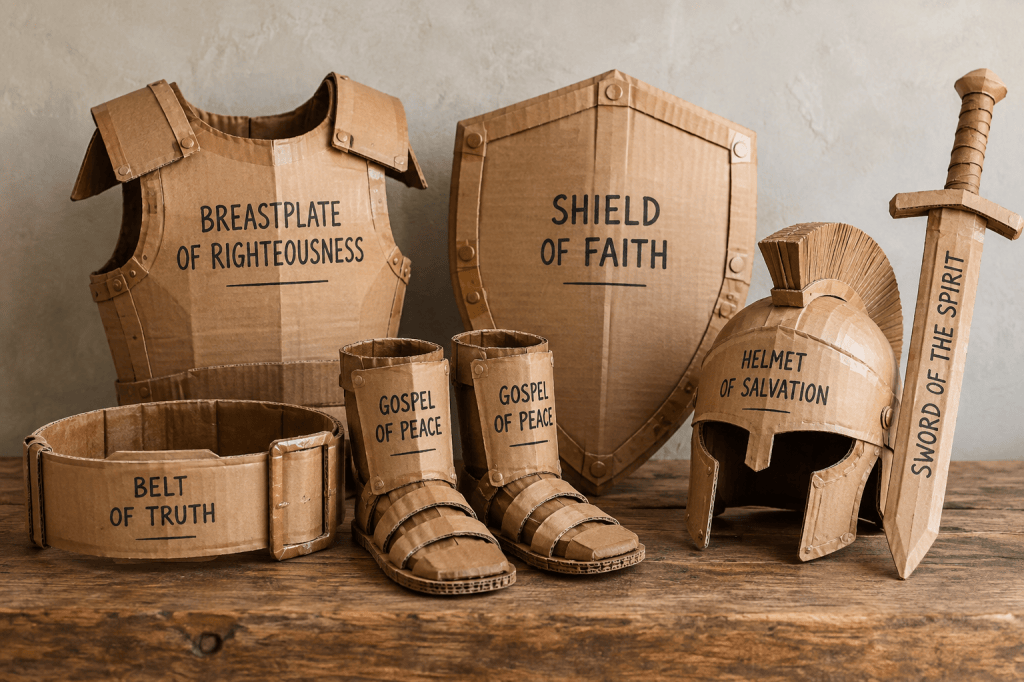
If you spent your childhood Sundays in church, you may remember the Armor of God.
Maybe it was Sunday school or Vacation Bible School. We colored pictures of Roman soldiers. We cut shields out of cardboard, made swords from construction paper, and carefully labeled every piece.
The Belt of Truth.
The Breastplate of Righteousness.
The Gospel of Peace.
The Shield of Faith.
The Helmet of Salvation.
The Sword of the Spirit.
Somewhere along the way, we grew up.
The cardboard shield disappeared. The paper sword ended up in a box—or the trash. And the Armor of God became one of those familiar Bible lessons we carried with us from childhood.
We knew the pieces. We knew their names. We knew the story.
We just may not have understood yet that one day we would actually need the armor.
Because the battles we would eventually face looked very different from anything we imagined while cutting shields out of cardboard.
A diagnosis isn’t the enemy.
A struggling marriage isn’t the enemy.
A child making painful choices isn’t the enemy.
A loved one who hurts us isn’t the enemy.
But these can become places where fear, accusation, temptation, bitterness, deception and hopelessness begin telling us what to believe—and influencing how we respond.
Paul reminds us:
“For our struggle is not against flesh and blood, but against the rulers, against the authorities, against the powers of this dark world and against the spiritual forces of evil in the heavenly realms.”
Ephesians 6:12
That changes how we understand the battle.
The person in front of us isn’t the enemy. The difficult circumstance isn’t the enemy. But in the middle of those circumstances, there is a very real battle over what we will believe, whom we will trust and how we will respond.
And suddenly, the Armor of God isn’t just a children’s Sunday school lesson.
It’s instruction for how to stand when life gets real.
Before the Armor
Paul doesn’t actually begin with the armor.
He begins here:
“Finally, be strong in the Lord and in his mighty power.”
Ephesians 6:10
That’s important.
The instruction isn’t:
Be stronger.
Try harder.
Toughen up.
Handle it better.
It’s:
Be strong in the Lord.
The armor that follows is God’s armor.
His truth.
His righteousness.
His gospel.
Faith in Him.
His salvation.
His Word.
All surrounded by prayer.
“The LORD is my strength and my shield; my heart trusts in him, and he helps me.”
Psalm 28:7
Putting on the Armor of God isn’t about becoming strong enough to handle whatever comes.
It’s learning where our strength actually comes from.
And perhaps that changes the question.
Instead of asking:
Am I strong enough for what I’m facing?
Maybe we ask:
Am I learning to depend on the One who is?
So How Do We Put It On?
Paul writes:
“Stand firm then, with the belt of truth buckled around your waist…”
Ephesians 6:14
The armor isn’t something we hurriedly search for when life falls apart.
We learn to wear it now.
The Belt of Truth — Know What Is True
Everything begins with truth.
But we live surrounded by voices telling us what truth is.
The families who raised us taught us what was normal—sometimes intentionally, and sometimes simply by the way they lived.
Friends influence what we accept.
Teachers, churches, workplaces and communities shape how we see the world.
Social media puts thousands of opinions in front of us every day, often repeating the same messages until they begin to sound true.
Culture tells us what is good, what is harmful, what success looks like, what love should look like, and even who we should be.
Then there are the voices within us.
Our experiences have a voice.
Our emotions have a voice.
Our wounds have a voice.
Fear has a voice.
And sometimes the things we’ve believed for so long feel like truth simply because we’ve never thought to question them.
But following Jesus eventually brings us to a difficult question:
When all of these voices disagree, who gets the final word?
Jesus prayed:
“Sanctify them by the truth; your word is truth.”
John 17:17
Putting on the belt of truth means allowing God’s Word to become the standard by which every other voice is measured—including our own.
It means being willing to discover that something our family taught us, something our culture celebrates, something our friends believe, or even something we have believed our entire lives needs to change when it doesn’t align with God.
And that means learning God’s truth before we desperately need it.
It means reading Scripture when there isn’t a crisis. Studying it. Asking questions. Allowing it to correct us. Learning the character of God and becoming familiar with His voice.
We don’t ask God’s Word to conform to what we already believe. We allow what we believe to be conformed to God’s Word.
Because when the battle comes, there will be plenty of other voices telling us what to believe.
That’s not the moment we want to begin deciding what is true.
We learn His truth now, so when the battle comes, we know which voice gets the final word.
The Breastplate of Righteousness
Once we know what is true, the next question becomes:
Will we live according to it?
Paul writes:
“Stand firm then, with the belt of truth buckled around your waist, with the breastplate of righteousness in place.”
Ephesians 6:14
A Roman breastplate protected the chest—the heart and other vital organs.
But before we think of righteousness simply as “doing the right thing,” we need to understand where biblical righteousness begins.
It doesn’t begin with us.
Scripture doesn’t tell us to become good enough that God will finally consider us righteous.
In fact, Paul specifically rejected that idea:
“…not having a righteousness of my own that comes from the law, but that which is through faith in Christ…”
Philippians 3:9
Our righteousness before God comes through Christ.
“God made him who had no sin to be sin for us, so that in him we might become the righteousness of God.”
2 Corinthians 5:21
That’s an important distinction.
The breastplate isn’t:
I have behaved well enough, therefore I am protected.
It begins with:
I belong to Christ. I have been forgiven. I have been justified. My standing before God rests on what Jesus has done—not on my ability to be perfect.
That’s protection we desperately need because one of the most effective attacks against the heart is accusation.
Look what you’ve done.
God couldn’t possibly forgive that.
You’re a failure.
You call yourself a Christian?
But Scripture answers:
“Who will bring any charge against those whom God has chosen? It is God who justifies.”
Romans 8:33
And:
“Therefore, there is now no condemnation for those who are in Christ Jesus.”
Romans 8:1
Our righteousness is not confidence in our goodness. It is confidence in Christ.
But that’s only half of the picture.
Because the righteousness we receive through Christ is meant to change the way we live.
Paul tells believers:
“…put on the new self, created to be like God in true righteousness and holiness.”
Ephesians 4:24
Grace doesn’t simply forgive us and leave us unchanged.
It teaches us to live differently.
“For the grace of God has appeared that offers salvation to all people. It teaches us to say ‘No’ to ungodliness… and to live self-controlled, upright and godly lives…”
Titus 2:11–12
So the breastplate has another very practical question for us:
Am I living according to what God says is right?
Not because obedience earns God’s love. Not because Christians never fail.
But because what we believe should change how we live.
And this is where righteousness becomes protective.
Proverbs gives us language remarkably similar to Paul’s armor:
“Righteousness guards the person of integrity…”
Proverbs 13:6
Think about how that works in ordinary life.
Someone hurts us.
Truth tells us what God says.
But righteousness determines what we do next.
Do I retaliate?
Do I gossip?
Do I become bitter?
Do I lie to protect myself?
Do I compromise because obedience is uncomfortable?
Or do I ask:
What would obedience to God look like here?
Sometimes righteousness means forgiving.
Sometimes it means confessing our own sin.
Sometimes it means telling the truth when lying would be easier.
Sometimes it means refusing temptation.
Sometimes it means establishing a necessary boundary.
Sometimes it simply means doing the next thing God has asked us to do when every emotion in us wants to do something else.
And when we fail—and we will—righteousness doesn’t mean hiding from God in shame.
It means coming back into the light.
“If we confess our sins, he is faithful and just and will forgive us our sins and purify us from all unrighteousness.”
1 John 1:9
That’s where we have to learn the difference between conviction and condemnation.
Condemnation says: You sinned. Hide from God. You’re hopeless.
Conviction says: This is sin. Bring it to God. Repent. Receive His forgiveness. Return to obedience.
One drives us away from God.
The other brings us back into alignment with Him.
And there’s something even deeper behind Paul’s imagery.
Paul wasn’t the first biblical writer to picture righteousness as armor.
Isaiah described God Himself:
“He put on righteousness as his breastplate, and the helmet of salvation on his head…”
Isaiah 59:17
So when Paul tells us to put on the breastplate of righteousness, he isn’t describing some righteousness we manufacture for ourselves.
We are putting on what comes from God.
The belt of truth asks:
What does God say is true?
The breastplate of righteousness asks:
Because that is true, how should I live?
And underneath both is the gospel:
I don’t obey so that Christ will make me righteous.
In Christ, I have received a righteousness I could never earn, so now I am learning to live like someone who belongs to Him.
That is how we put on the breastplate.
And when the battle comes, we aren’t standing there trying to prove that we’re good enough.
We’re standing in what Christ has done while choosing to walk in what He says is right.
Feet Fitted with the Readiness of the Gospel of Peace
The third piece of armor is:
“…with your feet fitted with the readiness that comes from the gospel of peace.”
Ephesians 6:15
We can easily misunderstand peace. We may think peace means no disagreement, keeping everyone happy, avoiding difficult conversations, or making uncomfortable situations feel better.
But biblical peace is much deeper.
Peace begins with being reconciled to God through Jesus.
“Therefore, since we have been justified through faith, we have peace with God through our Lord Jesus Christ.”
Romans 5:1
“For he himself is our peace…”
Ephesians 2:14
Because of Christ, we are no longer separated from God. That gives us a peace that does not depend upon everyone around us agreeing with us or our circumstances being easy.
Jesus said:
“Peace I leave with you; my peace I give you. I do not give to you as the world gives.”
John 14:27
Biblical peace is not the absence of conflict. It is the presence and rule of Christ in the middle of it.
That changes how we walk into difficult situations.
Scripture tells us:
“If it is possible, as far as it depends on you, live at peace with everyone.”
Romans 12:18
And:
“Make every effort to live in peace with everyone and to be holy…”
Hebrews 12:14
Notice that Scripture does not separate peace from holiness. We are not called to compromise truth or righteousness simply to prevent disagreement. Jesus calls us to be peacemakers (Matthew 5:9), not people who preserve an appearance of peace at any cost.
James describes godly wisdom as both pure and peace-loving, producing a “harvest of righteousness” (James 3:17–18). Truth, righteousness, and peace work together.
The gospel gives our feet a firm place to stand—and it gives us good news worth carrying wherever we go.
“How beautiful on the mountains are the feet of those who bring good news, who proclaim peace…”
Isaiah 52:7
Paul repeats this in Romans 10:15: “How beautiful are the feet of those who bring good news!”
The gospel gives us something worth carrying.
Christ made peace between us and God. His peace steadies us. And wherever our feet take us, we are prepared to carry that good news to others.
That means I can speak truth and still carry peace.
I can disagree and still carry peace.
I can establish a boundary and still carry peace.
I can walk into uncertainty without allowing fear to determine how I respond.
“Let the peace of Christ rule in your hearts…”
Colossians 3:15
“And the peace of God…will guard your hearts and your minds in Christ Jesus.”
Philippians 4:7
The gospel does not promise that everywhere our feet go will be peaceful.
It prepares us to carry the peace of Christ wherever our feet go.
And when the ground beneath us feels uncertain, that peace helps us do what Paul repeatedly tells us to do:
Stand.
And Then the Arrows Come
The Shield of Faith
“In addition to all this, take up the shield of faith, with which you can extinguish all the flaming arrows of the evil one.”
Ephesians 6:16
Paul doesn’t say the arrows won’t come.
He tells us to raise the shield when they do.
Those arrows can come through fear, disappointment, temptation, accusation, circumstances, or even the wounds caused by other people.
And sometimes the most dangerous part isn’t simply what happened.
It’s what we begin to believe because it happened.
“So we fix our eyes not on what is seen, but on what is unseen…”
2 Corinthians 4:18
Faith doesn’t deny what we see. It doesn’t deny what we feel.
I was hurt.
I was betrayed.
I was afraid.
I was treated unfairly.
Those things may be true.
But sometimes we take what happened to us and begin calling everything we concluded from it “my truth.”
I was hurt, therefore I cannot trust people.
Someone betrayed me, therefore I assume the worst about their motives.
I was treated unfairly, therefore I see every disagreement through the lens of injustice.
Someone wounded me, therefore my anger toward them is justified.
The experience may be true.
Our interpretation of everyone and everything through that experience may not be.
Faith asks us to bring more than our circumstances before God.
It asks us to bring the conclusions we have drawn from them.
“Do not conform to the pattern of this world, but be transformed by the renewing of your mind.”
Romans 12:2
What happened to me may shape what I see, but it does not get to define how I see everything else.
God’s truth does.
Faith does not require me to deny the wound.
It requires me to surrender the lens the wound created.
Joseph understood this.
His brothers betrayed him and sold him into slavery. Years later, they stood before him needing mercy. Joseph did not pretend their actions weren’t evil.
“You intended to harm me, but God intended it for good…”
Genesis 50:20
Joseph could acknowledge both realities:
What they did was wrong. But what they did did not get to define Joseph’s response—or God’s story.
And that helps us understand what raising the shield can look like in our own lives.
The arrow:
They hurt me. I will never forgive them.
The shield of faith:
What they did was wrong, but their sin does not get to determine my response.
The truth:
“Forgive as the Lord forgave you.”
Colossians 3:13
The arrow:
I’ve been hurt before. I have to protect myself from ever being hurt again.
The shield of faith:
My fear does not get to determine my next step.
The truth:
“When I am afraid, I put my trust in you.”
Psalm 56:3
The arrow:
Look at what they did. They deserve my hatred and condemnation.
The shield of faith:
I can recognize sin without allowing it to determine the posture of my heart.
The truth:
“Do not be overcome by evil, but overcome evil with good.”
Romans 12:21
The arrow:
Look at what is happening. Nothing good can come from this.
The shield of faith:
What I can see right now is not the whole story.
The truth:
“In all things God works for the good of those who love him…”
Romans 8:28
And the next verse helps us understand something about that good:
“…to be conformed to the image of his Son.”
Romans 8:29
The shield of faith doesn’t pretend the arrow isn’t real.
It stops the arrow from becoming the lens through which we see everything else.
God may change the circumstance. He may change the other person.
But sometimes, while we’re asking God to change what is happening around us,
He is forming Christ within us.
My faith isn’t the shield because I believe hard enough.
My faith is the shield because it places my confidence in the One who is faithful.
The Helmet of Salvation — Remember Whose You Are and Where Your Hope Rests
Battles don’t only challenge what we believe about God.
They can challenge what we believe about ourselves—and where we believe our hope lies.
Maybe I’m a failure.
Maybe God is disappointed in me.
Maybe I’m not really forgiven.
Maybe I need to prove myself.
Maybe this situation will never change.
Paul says:
“Take the helmet of salvation…”
Ephesians 6:17
But what exactly is the salvation we are being told to put on?
Scripture tells us that apart from Christ, we were spiritually dead in sin. But because of God’s great love and mercy, He made us alive with Christ:
“But because of his great love for us, God, who is rich in mercy, made us alive with Christ even when we were dead in transgressions—it is by grace you have been saved. And God raised us up with Christ and seated us with him in the heavenly realms in Christ Jesus… For it is by grace you have been saved, through faith—and this is not from yourselves, it is the gift of God—not by works, so that no one can boast.”
Ephesians 2:4–9
That is salvation.
We were dead in sin.
God made us alive in Christ.
We could not earn it.
God gave it by grace.
We could not accomplish it through our own goodness.
We receive it through faith in Jesus.
And Paul uses the picture of a helmet elsewhere to describe “the hope of salvation” (1 Thessalonians 5:8).
Salvation therefore reminds us that our standing with God does not rest on our performance, our circumstances, or another person’s choices.
“Therefore, there is now no condemnation for those who are in Christ Jesus.”
Romans 8:1
We don’t fight for salvation.
We stand from salvation.
Our confidence isn’t:
I’ve been good enough.
It’s:
Jesus is enough.
But salvation also reminds us that what we see right now is not the end of the story.
A circumstance may still be unresolved.
A prayer may still seem unanswered.
Someone we love may still be making choices we cannot control.
The battle may not end the way we hoped.
But our ultimate hope was never supposed to rest in the outcome of the battle.
It rests in Christ.
The helmet of salvation reminds us not only whose we are, but where our story is ultimately headed.
So when the battle begins telling us that everything is hopeless, salvation answers:
My hope is not limited to what I can see right now.
I belong to Christ.
I have been saved by grace through faith.
And whatever happens here, my hope is secure in Christ.
The Sword of the Spirit — Know What to Reach For
Paul continues:
“…and the sword of the Spirit, which is the word of God.”
Ephesians 6:17
This is different from the belt of truth.
The belt of truth asks:
What is true?
The sword of the Spirit asks:
What has God said that speaks directly into this battle?
We see Jesus do exactly this when Satan tempts Him in the wilderness.
Again and again Jesus responds:
“It is written…”
Matthew 4:4, 7, 10
Jesus didn’t answer temptation with His feelings, His circumstances, or an argument.
He brought the Word of God directly against the lie, temptation, or distortion being placed before Him.
That is why knowing Scripture matters before the battle.
When temptation says:
Just this once. It doesn’t really matter.
I need to know what God has said:
“If you love me, keep my commands.”
John 14:15
When fear says:
You are alone. You cannot handle what is coming.
I need to know what God has said:
“Do not fear, for I am with you…”
Isaiah 41:10
When bitterness says:
They don’t deserve your forgiveness.
I need to know what God has said:
“Forgive as the Lord forgave you.”
Colossians 3:13
When everything in me says:
Trust what you feel. Do what makes sense to you.
I need to know what God has said:
“Trust in the LORD with all your heart and lean not on your own understanding.”
Proverbs 3:5
A sword isn’t very useful if we’ve never learned how to handle it.
Owning a Bible isn’t the same as knowing Scripture.
We read it.
Study it.
Wrestle with it.
Memorize it.
Hide it in our hearts.
“I have hidden your word in my heart that I might not sin against you.”
Psalm 119:11
So when the battle comes, we aren’t desperately searching for something to believe.
We know where to reach.
The belt helps me know the truth.
The shield helps me trust the truth when it is tested.
And the sword gives me God’s Word to use when that truth is challenged.
And Through All of It — Pray
Paul doesn’t finish with the sword.
He continues:
“And pray in the Spirit on all occasions with all kinds of prayers and requests…”
Ephesians 6:18
Prayer isn’t an emergency flare we shoot toward heaven after everything else fails.
It is dependence running through the entire armor.
Prayer sounds like:
God, show me what is true.
Show me where I need to obey.
Help me respond like Jesus.
Protect my mind from what isn’t true.
Help me trust You when I cannot see what You’re doing.
Give me Scripture for what I’m facing.
Show me what is mine to do—and what I need to entrust to You.
Sometimes prayer is where we finally admit:
I cannot fix this.
And instead of that being defeat, it becomes dependence.
Prayer keeps the armor from becoming another exercise in self-reliance.
It keeps us connected to the One whose armor we’re wearing.
The Armor Works Together
Truth tells me what to believe.
Righteousness calls me to live according to it.
Peace shapes how I walk through it.
Faith trusts God when what I believe is tested.
Salvation reminds me what Christ has done and where my hope rests.
The Word gives me God’s truth to use in the battle.
Prayer keeps me dependent on Him through all of it.
And all of it leads to one repeated command:
Stand.
What If God Doesn’t Immediately Take Me Out of It?
We naturally pray for deliverance.
And Scripture gives us every reason to bring those prayers to God.
Even Jesus prayed in Gethsemane:
“My Father, if it is possible, may this cup be taken from me. Yet not as I will, but as you will.”
Matthew 26:39
Wanting relief isn’t a lack of faith.
Asking God to change circumstances isn’t wrong.
But biblical faith goes one step further:
God, I want this changed. But more than I want escape, I want Your will.
Paul asked God three times to remove his thorn.
God’s answer wasn’t removal.
It was:
“My grace is sufficient for you, for my power is made perfect in weakness.”
2 Corinthians 12:9
Sometimes God delivers us from the fire.
Sometimes, as with Shadrach, Meshach and Abednego, we discover God with us in it.
Their declaration before entering the furnace captures this kind of faith:
“The God we serve is able to deliver us…”
Daniel 3:17
And then:
“But even if he does not…”
Daniel 3:18
There it is.
Even if. Still.
God can deliver me.
I will pray for deliverance.
I will ask Him to change what needs changing.
But my faithfulness cannot depend upon receiving the outcome I want.
Because sometimes God does something in the waiting that could not have happened through immediate escape.
“Suffering produces perseverance; perseverance, character; and character, hope.”
Romans 5:3–4
The battle may involve someone else who desperately needs to change.
But they may not be the only person God is working on.
God can work in me even while I wait for Him to work in someone else.
When the Cardboard Armor Comes Off
Maybe some of us haven’t thought much about the Armor of God since we were children.
Once, we knew every piece because someone taught us how to make it.
Now we need to learn how to wear it.
Because we don’t know what tomorrow will require of our faith.
We don’t know when our beliefs will be challenged.
We don’t know when obedience will become costly.
We don’t know when someone we love will need us to stand beside them and pray when we have absolutely no idea what else to do.
But we don’t need to fear tomorrow.
Jesus described a house built on rock:
“The rain came down, the streams rose, and the winds blew and beat against that house; yet it did not fall…”
Matthew 7:25
Jesus said the one who hears His words and puts them into practice is like a wise man who built his house on rock.
The storm still came.
Jesus wasn’t teaching us how to avoid the storm. He was teaching us how to build our lives on Him so that when it comes, we can stand.
So build your faith.
Know His Word.
Learn obedience.
Practice prayer.
Know the voice of the One you follow.
Don’t wait for the battle to discover what you believe.
Put on the armor now.
Because the armor isn’t about controlling the battle.
It isn’t a promise that the weapon won’t form.
It isn’t a promise that the arrow won’t be fired.
And it isn’t a promise that every situation will end the way we hoped.
It’s about being equipped by God to stand faithfully within it.
The battle may come.
The arrow may fly.
The circumstances may not change.
“…and after you have done everything, to stand.”
Ephesians 6:13


Leave a comment