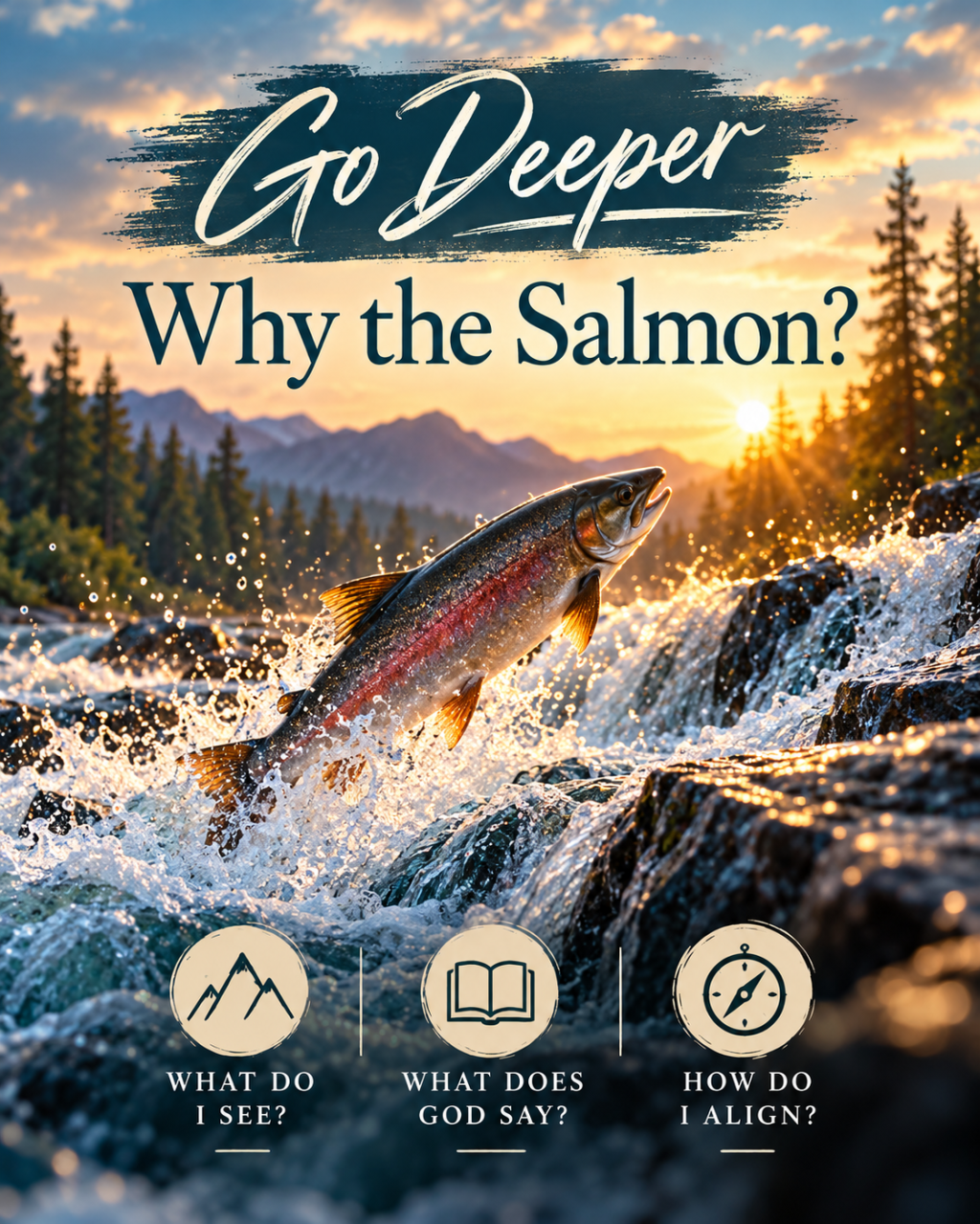
What Do I See? • What Does God Say? • How Do I Align?
The reflection Why the Salmon? began with a moment of exhaustion.
“I feel like a salmon swimming upstream pointlessly, only to meet my death in the end.”
What I could see was resistance.
What I could feel was exhaustion.
But 2 Corinthians 4 reminded me that what I can see is not the whole story.
This study isn’t meant to simply reinforce the ideas in the reflection. It’s an invitation to examine your own current against Scripture.
Grab your Bible and something to write with.
Don’t answer with what you think the Christian answer should be.
Start with what is actually true about where you are.
Then let God’s Word challenge it.
1. WHAT DO I SEE?
Honest Reflection
Before we look at what Scripture says, let’s identify what we are actually seeing.
Think about an area of your life that currently feels like swimming upstream.
Maybe it’s a relationship.
Your family.
Your work.
Your finances.
A decision.
A loss.
A season of waiting.
A conviction that has become costly.
A pattern you’re trying to break.
Or simply the exhaustion of trying to remain faithful when it seems like going another direction would be easier.
Name Your Current
What feels difficult right now?
Write it plainly:
My current is: __________________________
Now go deeper.
What about this situation is exhausting you? ____________________
What are you afraid might happen? ______________________
What outcome are you trying hardest to control? _________________
What do you wish God would change? __________________________
Where are you tempted to stop fighting the current and simply drift? _________
What Story Am I Telling Myself?
Sometimes circumstances are real, but the conclusions we draw from them aren’t necessarily true.
Complete these statements:
Because this is happening, I believe ____________________.
If this doesn’t change, I am afraid ____________________.
What I most want God to do is ____________________.
If I could control the outcome, I would ____________________.
Now look at what you wrote.
Don’t correct it yet.
Just be honest about it.
This is what I see.
2. WHAT DOES GOD SAY?
Let Scripture Interpret the Current
Now we move from what we see to what God has said.
Our circumstances matter.
Our emotions are real.
Our experiences affect us.
But none of those things get the final word.
My experience is real, but it is not my authority. God’s Word is.
Read 2 Corinthians 4:16–18
Read it slowly.
Then read it again.
Pay attention to the contrasts Paul makes:
Outwardly wasting away — inwardly being renewed.
Momentary trouble — eternal glory.
What is seen — what is unseen.
Temporary — eternal.
Now ask:
Which side of those contrasts has been receiving most of my attention?
Am I primarily watching what is happening around me, or am I trusting God for what He is doing within me and beyond what I can see?
Paul doesn’t tell us the suffering isn’t real.
He tells us it isn’t the whole story.
Write It Down
What in your current situation is temporary?
____________________________
What truth about God remains true regardless of what happens?
____________________________
What might I be unable to see from where I am standing?
____________________________
3. WHAT IS THE CURRENT PRODUCING?
Read Romans 5:3–5
Notice the progression:
Suffering → Perseverance → Character → Hope
We naturally want to get from suffering to hope as quickly as possible.
But Scripture puts something between them.
Perseverance and character.
The current isn’t necessarily evidence that something has gone wrong.
Sometimes God is doing something in us while we are asking Him to do something around us.
Now Look Inward
When life becomes difficult, what tends to come out of you?
Fear?
Anger?
Control?
Avoidance?
Bitterness?
People-pleasing?
Self-reliance?
Prayer?
Patience?
Trust?
Integrity?
Ask Yourself Honestly
What is this current revealing about my character?
What is God showing me about myself that I might not have seen in calmer water?
And then:
Am I asking God to remove something He may be using to develop perseverance and character in me?
That doesn’t mean we should seek suffering or remain in harmful situations unnecessarily.
It means difficulty isn’t automatically purposeless.
Sometimes we pray:
God, change the current.
And God may also be doing something deeper:
Changing us in the current.
4. AM I ACTUALLY SWIMMING IN GOD’S DIRECTION?
Read Romans 12:1–2
There is an important distinction here. Going against the crowd doesn’t automatically mean we’re following God. Being uncomfortable doesn’t automatically mean we’re obedient. Being opposed doesn’t automatically make us right.
Scripture determines the direction—not the current.
Romans 12:2 tells us:
“Do not conform to the pattern of this world, but be transformed by the renewing of your mind.”
So don’t simply ask:
Am I swimming upstream?
Ask:
Am I swimming toward God?
Examine Your Direction
Where has culture influenced how you think about this situation?
Where have other people’s opinions become louder than Scripture?
Where are your feelings determining what you believe is true?
Where might pride, fear, hurt, or anger be disguising itself as conviction?
Then ask the most important question:
What does Scripture actually tell me to do?
If you don’t know, don’t manufacture an answer.
Search Scripture.
Pray.
Seek wise biblical counsel.
The goal isn’t merely to keep swimming.
The goal is faithfulness to God.
5. WHERE AM I TEMPTED TO FLOAT DOWNSTREAM?
Read Galatians 1:10 and James 1:22–25
Floating is easier than swimming against a current. And sometimes compromise doesn’t look dramatic.
Sometimes it looks like:
Staying silent when truth needs to be spoken in love.
Holding onto resentment instead of beginning the work of forgiveness.
Choosing approval over conviction.
Responding to someone according to what they deserve rather than according to who Christ has called us to be.
Knowing what Scripture says but delaying obedience because it is uncomfortable.
Make It Real
Complete these two sentences:
If I simply floated downstream in this situation, I would ____________________.
If I obeyed what God has said, I would ____________________.
Now compare your answers.
What is obedience going to cost you?
Comfort?
Approval?
Control?
Pride?
Convenience?
Being understood?
Having the last word?
That may be where your upstream journey actually begins.
6. WHAT HAS GOD GIVEN ME FOR THE JOURNEY?
Read 2 Peter 1:3–8
Pay particular attention to verse 3:
“His divine power has given us everything we need for a godly life…”
God doesn’t call us upstream and then abandon us in the river.
Read the qualities Peter describes:
Faith.
Goodness.
Knowledge.
Self-control.
Perseverance.
Godliness.
Mutual affection.
Love.
Now consider your situation again.
Change the Question
Instead of only asking:
“God, why haven’t You changed this?”
ask:
“God, what have You already given me for this?”
His Word?
His Spirit?
Wisdom?
Prayer?
Christian community?
Someone who can counsel you?
An opportunity to practice self-control?
A truth you need to believe?
A command you already know you need to obey?
Personal Inventory
What has God already provided that I am not fully using?
What do I keep asking God for that He may have already addressed in Scripture?
Where am I relying primarily on my own strength?
7. WHO IS SWIMMING BEHIND ME?
Read Psalm 78:4–7
Then read Deuteronomy 6:4–9.
Both passages point toward something bigger than an individual’s faith.
Truth is passed on.
Faithfulness has influence.
That doesn’t mean we perform Christianity so other people will think highly of us.
It means our choices rarely affect only us.
Think About Your Influence
Who is watching how you navigate this season?
Your children?
Your grandchildren?
A friend?
A coworker?
Someone you mentor?
Someone whose name may never occur to you?
Now ask yourself something uncomfortable:
If someone learned how to handle hardship by watching me right now, what would I be teaching them?
What would they learn about:
Faith?
Fear?
Forgiveness?
Integrity?
Conflict?
Truth?
Humility?
Trust?
Would they see someone whose convictions disappear when obedience becomes costly?
Or would they see someone who struggles honestly but continues turning back toward God?
You don’t have to navigate the current perfectly to influence someone faithfully.
But you do have to know which direction you’re swimming.
8. HOW DO I ALIGN?
From Biblical Truth to Actual Obedience
Now return to the very first thing you wrote:
My current is: ____________________.
You have identified what you see. You have examined what Scripture says.
Now comes the part that matters:
What needs to change in me so that my response aligns with what God has said?
Maybe your circumstances don’t change today.
But perhaps your response can.
Compare the Two
What I currently believe:
What God’s Word says:
Where they don’t align:
What I need to surrender:
What I need to believe:
What I need to do:
Don’t leave that last answer vague.
“I need to trust God more” is difficult to act on.
Ask instead:
What would trusting God actually cause me to do differently tomorrow?
“I need to forgive” is a beginning.
Ask:
What is one action consistent with forgiveness that I can take?
“I need courage.”
Ask:
What conversation, decision, or act of obedience am I avoiding because I’m afraid?
Faith becomes visible through obedience.
9. TAKE THE NEXT STROKE
Read Psalm 119:105
“Your word is a lamp for my feet, a light on my path.”
Sometimes we want enough light to see the entire river. God may give us enough light for the next step. You may not know how your situation ends. You may not understand why God has allowed this season. You may not know what He’s producing through it.
But perhaps you already know what faithfulness requires next.
Within the Next 48 Hours…
I will:
________________________________________
Be specific enough that you will know whether you actually did it.
Then consider telling one trusted person what you have decided.
Not because accountability earns anything from God.
Because intentions are easy.
Obedience requires movement.
EVEN IF, STILL
Now bring everything together.
There are two things in front of you.
One may be outside your control.
The other isn’t.
My Even If
Name the circumstance.
Even if ____________________________________________.
Even if God doesn’t change this as quickly as I want.
Even if someone doesn’t understand.
Even if obedience costs me something.
Even if I don’t know how this ends.
Even if the current remains strong.
Now identify your response.
My Still
Still, I will ________________________________________.
Still I will forgive.
Still I will tell the truth.
Still I will wait.
Still I will obey.
Still I will trust.
Still I will follow Christ.
Still I will keep my eyes on what is unseen.
Don’t choose the answer that sounds best.
Choose the one Scripture requires of you.
Then take the next stroke.
Before You Finish
Return to 2 Corinthians 4:16–18 one more time.
Read it slowly.
The current may still be there when you close your Bible. The circumstances may look exactly the same. The person may not have changed. The answer may still be unknown.
But perhaps the goal of opening Scripture wasn’t merely to discover how to change the current.
Perhaps it was to allow God’s truth to change how you see it, who you are becoming within it, and how you will respond to it.
What I see is temporary.
What God is doing is eternal.
And sometimes faith looks remarkably like continuing upstream when you cannot yet see why the journey matters.
Even if, still.


Leave a comment